
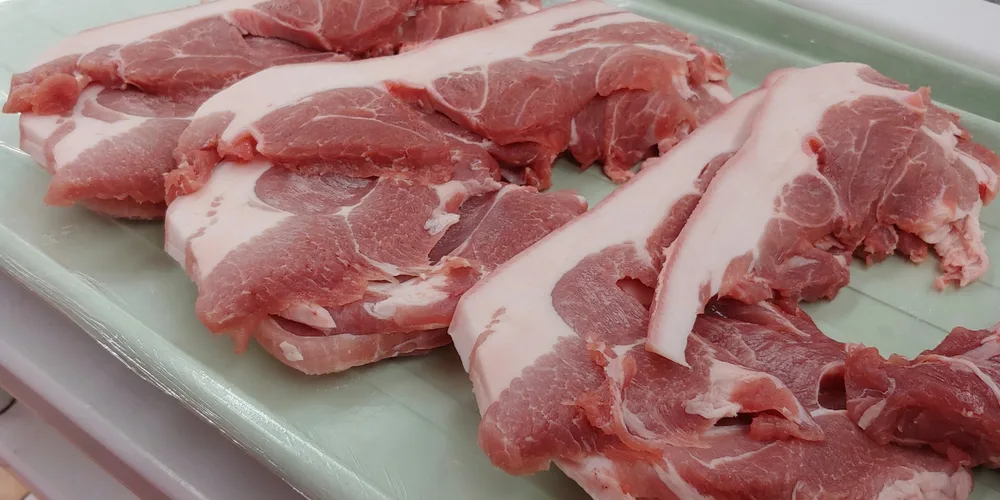
A kitchen, a butcher shop or a sausage workshop does not buy “pork” in general — it buys cuts: collar for the grill, loin for schnitzels, shoulder for mince, leg for roasting, trotters for brawn. Each part of the pig carries a different share of meat, fat and bone, so each has a different job and a different cost per portion. Below we go through them one by one, using only the lines that actually exist in the wholesale pork catalogue on carne.md.
Which pork cuts are in the catalogue?
We group them by where they come from on the carcass, because trade names get mixed up:
- Collar (neck) — chilled “Pork collar” and “Pork collar, boneless, frozen, 20 kg”.
- Shoulder and back — “Pork shoulder, boneless, frozen, 20 kg” and chilled “Pork back, boneless”.
- Loin and entrecôte — “Pork loin, boneless, frozen, 20 kg“, plus “Pork entrecôte, bone-in” and “Pork entrecôte, boneless”, both chilled.
- Tenderloin — chilled “Pork tenderloin” and “Pork tenderloin, frozen, 10 kg”.
- Leg — “Pork leg“, the whole hind leg (ham), chilled “Pork leg, boneless” and “Pork leg, boneless, frozen, 20 kg”.
- Belly and ribs — “Pork belly, bone-in”, “Pork belly, boneless, rind-on”, “Pork belly, frozen, 18 kg” and “Pork ribs, frozen, 10 kg“.
- Knuckle and trotters — “Pork knuckle” and “Pork trotters, frozen“.
- Processing meat — “Minced pork”, “Pork for patties”, “Diced pork (goulash cut)”, “Pork trimmings 70/30” and “Pork trimmings 80/20”.
- Half-carcass — “Pork half-carcass” and “Pork half-carcass, defatted”, chilled, for buyers who do their own butchery.
Pork offal — liver, heart, tongue, ears, lungs, caul fat — is listed separately on the offal page.
Which cut for which dish?
Grill and skewers. Collar is the most requested grilling cut: the fine fat running through it melts over the heat and keeps each slice juicy. Bone-in entrecôte and ribs also go on the grill. Cubes for pork skewers are usually cut from the collar or the leg.
Schnitzel, escalope, steak. Boneless loin and entrecôte slice evenly and give the same weight piece after piece — which matters when a kitchen works to a fixed portion weight. Boneless back is leaner than collar and portions easily for the pan or the wok.
Roasts. A whole roasted leg is the centrepiece of a festive table; boneless leg cuts into even pieces for the tray. Bone-in belly is cooked low and slow until the meat comes away from the ribs, while boneless rind-on belly is the piece for porchetta and home-cured belly.
Stews and goulash. Shoulder and ready-diced goulash cut handle long braising in sauce. The goulash cut arrives already diced, so the cubes are even and cook at the same pace.
Mititei, sausages, patties. The meat-to-fat ratio decides everything here. 70/30 trimmings are the classic raw material for mititei and fresh sausages; 80/20 is the leaner option for patties, fillings and recipes where fat is added separately. Shoulder is the all-round production cut. Sausage makers will find more in our guide to raw materials for sausage production; the lines themselves are grouped under meat processing raw materials.
Brawn, knuckle, soups. Pork trotters hold the collagen that makes brawn (răcituri) set on its own; the knuckle gives body and depth to boiled dishes and bean soups.
Fine dining. Tenderloin is the most tender cut of the pig: medallions in the pan or tenderloin in a crust from the oven are ready in minutes.
Looking for lean, boneless pork?
The leanest lines in the catalogue are the tenderloin, the boneless loin and entrecôte, and the boneless leg. Collar and belly, on the other hand, carry fat — which is exactly why they work so well on the grill and in the oven. If your menu calls for lean portions, start from the loin and the leg, not the collar.
Chilled or frozen?
It is a question of logistics, not quality. Chilled pork arrives cut into pieces through the cold chain and goes straight into production with no thawing — but it needs fast turnover. Frozen pork comes in 10, 18 or 20 kg cases, is stored at −18 °C and lets you restock periodically rather than daily. Thaw in the fridge and never refreeze; all the rules are in our guide to frozen meat storage and thawing.
Bone-in or boneless: how to judge the cost
The price per kilogram does not tell you what a portion costs. With bone-in cuts you also pay for the bone; with boneless cuts almost everything you buy ends up on the plate. A half-carcass, by contrast, gives the best price per kilogram to anyone with the staff and space to break it down, and the defatted half-carcass leaves less fat to trim. We cannot give you a fixed yield percentage — it depends on the batch and on how your team cuts — but you can measure it yourself: weigh, cut, separate clean meat from bone, fat and trim, and divide by the starting weight. The full method is in our article on meat yield and cost per portion.
What gets confirmed before you order
The pork in our catalogue is not a Qualiko product, and its stock is not fixed: every product page says “Check stock with our sales team”. Some frozen lines show an approximate price per kilogram, VAT included; prices are approximate and are confirmed by our sales agent together with stock and delivery time. Returns are not accepted, so confirm the exact pack and format you need on the phone.
How to order
We sell by the case, with a 70 kg minimum order that can be made up of several cuts — say collar, loin and ribs in one delivery, or pork together with chicken; every line is listed on the wholesale pork page. We deliver in Chișinău, usually within 24–48 hours, and across Moldova; delivery in Chișinău costs 100 lei and is free over 150 kg (details on the delivery page). We do not process online payments.
Send your request through the order request form or call +373 79 88 33 79 (the same number is on WhatsApp, Viber and Telegram) and tell us four things: which cuts, chilled or frozen, your estimated monthly volume and your town. We will reply with the current price and availability.
Frequently asked questions
What is the difference between pork collar, loin and entrecôte?
The collar is the neck end, with fat marbled through the meat, which is why it stays juicy on the grill. Loin and entrecôte come from the back: leaner meat that slices evenly into schnitzels, escalopes and steaks. Entrecôte is available bone-in and boneless; boneless loin comes in frozen 20 kg cases.
Which pork cut is best for mititei and sausages?
Shoulder is the all-round cut for mince, and 70/30 trimmings are the classic raw material for mititei and fresh sausages. For leaner mince there are 80/20 trimmings and the pork for patties.
Do you sell pork in small quantities?
No. We sell by the case, with a 70 kg minimum order. The 70 kg can be made up of several pork and chicken cuts in the same delivery.
How much does wholesale pork cost?
Prices are per kilogram, VAT included, and depend on the cut and the pack. Some frozen lines show an approximate price on the product page; every price and the stock are confirmed by our sales agent before delivery.