
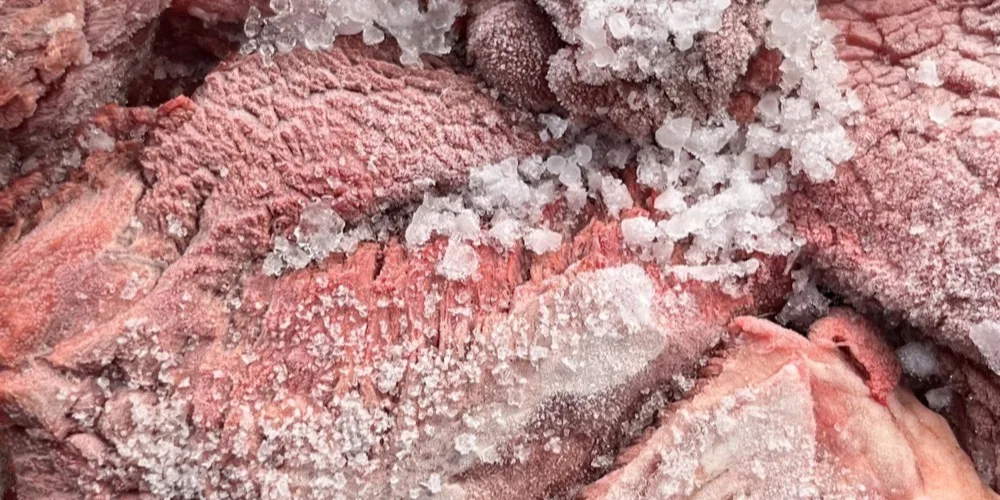
The short answer: frozen meat is held at -18 °C or colder, thawed in a chiller at 0…+4 °C, and raw meat that has been thawed is not refrozen. Below: why, how to plan thawing in a kitchen that runs daily, what to check at goods-in, and what it means when 10 kg of frozen product leaves you 8 kg after thawing.
The three temperatures that matter
- Frozen: -18 °C or colder, continuously. The minimum matters, not the daily average. Every excursion above the threshold partly melts the ice crystals inside the muscle; on refreezing they re-form larger and tear the muscle fibre. That is where dry, stringy meat comes from.
- Chilled: 0…+4 °C. Chilled meat is a short shelf-life product, not a fresher version of frozen. Buying it to freeze yourself in an ordinary freezer degrades it: slow freezing produces exactly those large crystals.
- Above +5 °C the question is no longer quality, it is safety.
A recording thermometer in every cold room, read and logged daily, is the cheapest check a kitchen can run. In an audit, the temperature log is the first document requested.
How to thaw properly in a professional kitchen
- In the chiller at 0…+4 °C, never on the bench. At room temperature the surface warms hours before the core thaws — and the surface is what gets contaminated.
- On a wire rack, over a tray, on the bottom shelf. The meat does not sit in its own drip, and run-off never lands on ready-to-eat product.
- Plan the day before, and match the pack format to your consumption. A 10 kg block-frozen monolith thaws whole or not at all — if you use three kilograms a day, it is the wrong format. “Chicken wings Qualiko, frozen, 10.8 kg (0.900×12)” describes the structure of the case: twelve pieces of roughly 0.900 kg. Whether those pieces are individually wrapped, so you can take one out and leave the rest sealed, is confirmed line by line with our sales desk.
- Never in warm water, next to a heat source, or under running water. A microwave only works if the product goes straight into cooking.
- Breaded semi-finished products are cooked from frozen. Qualiko’s Nuggets Homestyle, chicken popcorn, breaded sticks and breaded fillet: thaw them and the coating takes up water and falls off in the fryer.
Can thawed meat be refrozen?
The honest answer has two parts and neither of them is yes.
On quality, a second freeze finishes off whatever structure survived the first: drip loss becomes obvious and the meat turns tough and flat. On safety, you do not know how long it sat above the threshold the first time. Freezing halts bacterial growth; it does not remove bacteria, so the second cycle starts from a higher load.
The working rule: thawed raw product gets cooked, not returned to the freezer. A cooked dish can be frozen as a new product, with rapid chilling and a dated label. If your HACCP plan says otherwise, read it on paper, not from memory.
“I bought 10 kg and had 8 kg after thawing.” What is normal and what is not
This is a common complaint in the frozen meat trade and deserves a direct answer. Three different things hide behind one symptom:
- Protective glazing. A thin layer of ice applied deliberately to shield the product from oxidation and freezer burn. It is normal practice, but it has to be declared: the net weight must be the weight of the meat, not of the ice on it.
- Water added into the product during processing. That is not glazing, and it belongs in the label’s ingredient declaration. If it is not there, the problem is the supplier, not your freezer.
- Thaw drip. The meat’s own liquid, which comes out of any correctly made product — and increases when the cold chain was broken.
Verifying this needs a scale, not figures from an article. Weigh the sealed case at goods-in against the declared weight on the packaging, then weigh the product after full thawing and draining. One case proves nothing; the same result across three deliveries is a fact you take to your supplier. A producer’s technical specification can and should be requested — it is not a trade secret.
In our catalogue the format is written into the product name: “Chicken legs Qualiko, dry-frozen (IQF), 14 kg” tells you the pieces come loose, “Chicken leg quarters Qualiko, block-frozen (monolith), 10 kg” tells you they do not, and where a case is split into units a code of the form “0.900×12” is added. When something is unclear, the question on the phone is: what is the net weight of the case.
Cold chain on delivery: what to check at goods-in
Two minutes, before you sign, not after.
- The case: wet, deformed, or with refreeze marks at the bottom means it stood too long somewhere.
- The product: large ice crystals inside the bag, or pieces fused into a block where the product should be loose (IQF), indicate partial thawing.
- Temperature: measured between packs, not by piercing the product.
- The paperwork: non-conformity is recorded on the spot, on the delivery note. A phone complaint the next day has nothing behind it.
On our side: as the official Qualiko (MHP) distributor in Moldova we deliver wholesale in Chisinau and across the country under an unbroken cold chain, with price, stock and lead time confirmed by phone before dispatch. We do not process online payments — orders go through the request form, by phone or WhatsApp, with a 70 kg minimum.
If you are unsure which format fits, tell us your daily usage and your equipment. We will pick it together from the frozen range, the chilled range or the semi-finished products. Call +373 79 88 33 79 or write to office@carne.md.