
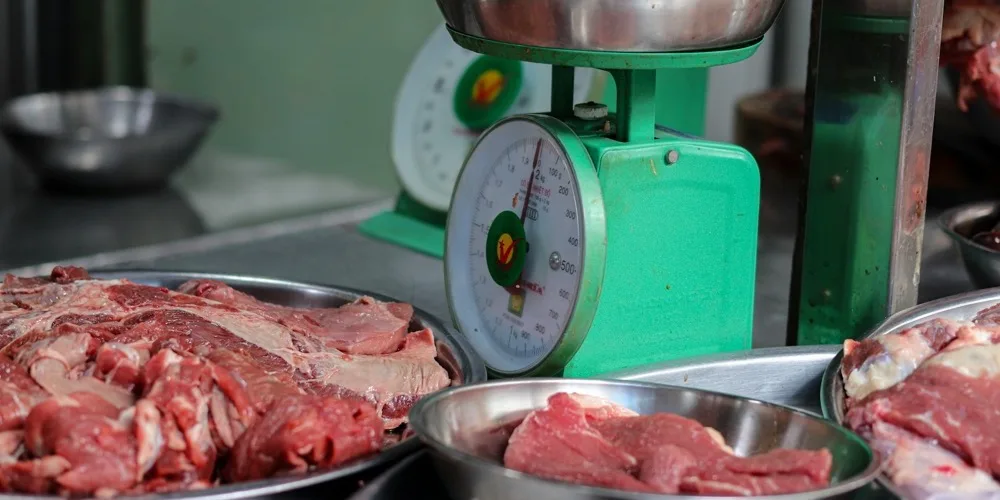
A price per kilo does not tell you what a portion costs. Two losses sit between them: what you throw away when you break the meat down, and what you lose when you cook it. The supplier who is cheaper per kilo can be the expensive one on the plate. What follows is the method — the numbers come from your own scale and from the quote you ask us for.
The formula: from price per kilo to cost per portion
Three quantities, in this order.
- Butchery yield (Y1). Trimmed meat divided by the raw weight you bought. On a boneless item Y1 is close to 1; on a bone-in item, clearly below.
- Cost of a kilo of trimmed meat. The price per kilo divided by Y1. If the price is P, your real cost is P ÷ Y1 — and that, not P, is the figure you compare across suppliers.
- Cooking yield (Y2). Plated weight divided by the raw weight that went into the pan or combi oven.
Cost per portion = (P ÷ Y1) × (g ÷ Y2) ÷ 1000, with g the plated grams and P the price per kilo. Run it once per item you compare: ten minutes that often change the decision.
Bone-in or boneless: deciding without guessing
“Is it cheaper to buy bone-in thighs and debone them myself?” has an honest answer: it depends on four things, three of them inside your kitchen.
- Your actual yield, not a textbook figure. It moves between batches and between butchers.
- Labour. Deboning minutes multiplied by the hourly cost of the station, divided by the kilos of trimmed meat produced. Add it to P ÷ Y1, or the comparison is fiction: labour never shows on the invoice, only in missed service.
- What the bones and skin become. Into stock, part of the cost comes back. Into the bin, it does not.
- The price of the boneless line, which you find out by asking: a catalogue item shows either an indicative wholesale price or “Price on request”, or asks you to check stock with our sales desk.
The practical rule: in-house deboning wins when your staff are on shift anyway, the yield is good and the bones have a use.
How much is left from 10 kg of bone-in thighs
We will not give you a percentage: it depends on calibre, on the batch and on how close to the bone your team works. You measure it, and the test takes an hour.
- Weigh the incoming batch precisely — frozen goods only after a full thaw in the chiller, or you are measuring water together with yield.
- Break it down at normal speed into four containers: meat, skin, bone, trim.
- Weigh each one. The total should come close to the starting weight; the gap is handling loss, and it belongs in the cost.
- Repeat on two or three batches and average them, not the best run.
That number is your Y1 for that item. If you would rather skip the step, the catalogue carries ready-boneless lines: “Chicken thigh fillet Qualiko (boneless, skinless), 10 kg” in frozen chicken, and pork collar, shoulder and leg in frozen pork.
Which cuts are economical for a canteen
“Economical” means cost per plated portion, not price per kilo. Check in this order.
- Boneless, low-waste lines — chicken breast fillet, minced pork, diced pork (goulash cut) and pork trimmings — have a Y1 near 1: the price per kilo is almost the real cost.
- Bone-in lines — chicken leg quarters, chicken wings, turkey drumsticks, pork ribs and bone-in pork entrecôte — go through Y1 before you place them next to the first group. Skip that and the comparison reads backwards.
- In stews, sauced dishes and moist oven cooking, cooking loss is smaller than on a grill, so Y2 is better — which sometimes moves the decision to the item that looked more expensive.
Take the lines from the wholesale catalogue: frozen (chicken, pork, beef, turkey), chilled (chicken, pork) and semi-finished products. A producer-portioned item moves the loss to the producer: Y1 equal to 1, zero labour. If it is cheaper per portion than your own butchery, that is the answer, whatever the per-kilo price looks like.
Markup and margin are not the same formula
For a retail shelf, the classic error is treating them as one thing.
- Markup = (selling price − cost) ÷ cost.
- Margin = (selling price − cost) ÷ selling price.
A 50% markup is a 33% margin. Set the target in one and price in the other, and the error shows up at stocktake rather than at the till.
The cost in that formula is not the purchase price: it is the price divided by Y1 if you cut in-store, then adjusted for shrinkage — write-offs, packaging, weight loss. Real cost per kilo sold = (P ÷ Y1) ÷ (1 − loss rate). Take the loss rate from your own stocktakes, not from an estimate.
What we cannot calculate for you
Displayed prices are indicative and we do not quote ranges: we confirm the final price per item, against the quantity you intend to buy. The minimum order is 70 kg. Delivery terms are confirmed with the order; we deliver in Chisinau and across Moldova.
Send the short list — the three or four items you are comparing — through the order request form, or call +373 79 88 33 79, Monday to Friday 9:00–17:00 and Saturday 9:00–14:00. We do not process online payments; our sales team confirms the offer. Then run the formulas and decide on cost per portion.