
With IQF meat every piece is frozen separately: you take out exactly what you need and the rest stays frozen. A block-frozen monolith is a whole case frozen as one solid piece, and it can only be thawed all at once. For a kitchen with day-to-day swings in demand, IQF is usually the right format; for a production line that runs the whole case through a single batch, block-frozen works just as well. Here is why, and what to check when the goods arrive.
What does IQF mean, and how is it labelled in the catalogue?
IQF stands for individually quick frozen. Pieces pass through intense cold one by one, so they don’t fuse together and pour freely out of the case. They are often protected by a thin ice glaze that prevents freezer burn; how thick that glaze is varies by producer and by line.
In the carne.md catalogue the format is labelled dry-frozen: “Chicken legs Qualiko, dry-frozen (IQF), 14 kg” and its superior-grade version, “Chicken tenderloin Qualiko, dry-frozen, 14 kg”, “Chicken wings Qualiko, 14–15 kg, dry-frozen” and “Chicken wing drumettes Qualiko, dry-frozen, 14 kg”.
What is a block-frozen monolith?
For a monolith, the pieces are packed into the case and frozen together. The result is a dense block that stacks and ships well, but you cannot break off two kilograms without thawing the lot or using a frozen-meat saw. In the catalogue the format is stated outright on “Chicken leg quarters Qualiko, block-frozen (monolith), 10 kg”.
For the other frozen cases — 10 kg boneless thigh fillet, shawarma chicken, 20 kg pork cases — the product name doesn’t say whether pieces are loose or blocked. Don’t assume: ask about each line before you order.
How do you portion and thaw each format?
- IQF: take out the day’s quantity, reseal the bag or case and return it to the freezer at once, so the remaining pieces don’t pick up condensation and stick together. Small pieces thaw faster, but still in the fridge, at 0…+4 °C.
- Block-frozen: the block thaws whole, in the fridge, on a rack over a drip tray. It takes longer than loose pieces — plan at least a day ahead; the exact time depends on your cold room and the block size. Once thawed, the entire quantity has to be used within normal chilled-meat limits.
- Both: no warm water, no thawing on the bench at room temperature, no refreezing.
At goods-in, weigh at least one trial batch net after thawing: glaze is water, not meat, and your real yield is calculated on drained meat.
How do you check IQF stock at goods-in?
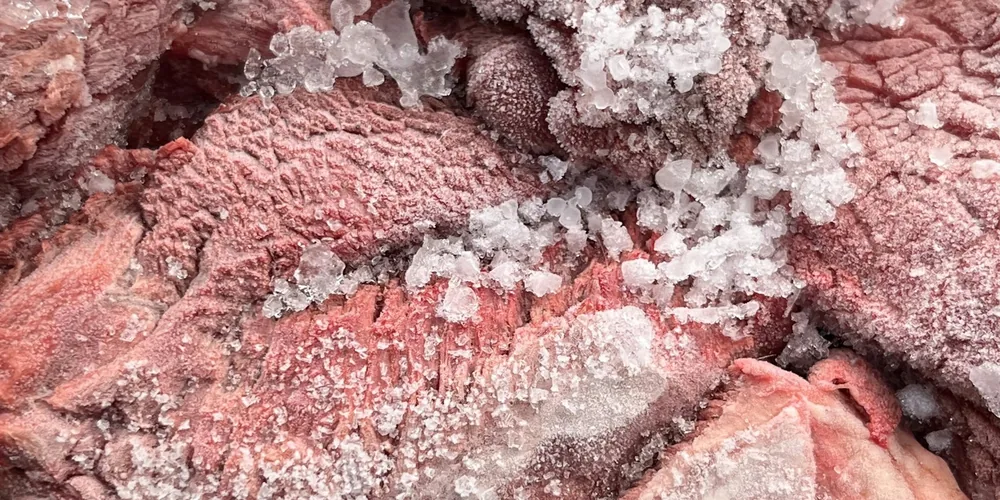
IQF pieces should move freely in the bag or case. If they have fused into a lump, with cloudy ice between them or a lot of large-crystal “snow” inside the pack, the product has most likely warmed up in transit and refrozen. Probe between packs and record the temperature in your goods-in log: frozen goods travel at −18 °C. With a monolith, the warning signs are soft block edges or a wet case. Note any deviation on delivery, with the driver present, not after the goods have gone into the cold room.
Which format suits a HoReCa kitchen?
Restaurants, pizzerias, shawarma kitchens and cafés see demand shift from one day to the next. IQF nearly always wins here: 3 kg on Tuesday, 6 kg on Friday, without opening a whole case and without binning thawed meat that didn’t sell. Dry-frozen wings and wing drumettes are the typical choice for bar menus and delivery; tenderloin suits precisely portioned dishes.
Block-frozen only makes sense in HoReCa if a whole case is used within a day or two — for a banquet, say, or a canteen with a fixed menu and a known number of covers.
Which format suits food production?
A sausage plant, a ready-meal workshop or a caterer cooking hundreds of portions from one product works in batches. If the whole block goes into one run, a monolith adds no extra handling and takes little space in the cold room. The constraint is thawing capacity: you need chiller space for the entire batch, on time. Where the daily batch is smaller than a case, IQF is the safer option.
Which format suits retail?
A shop has two clean options. For the freezer cabinet, 0.9 kg and 1 kg bags (wings, breast fillet, liver, hearts) go straight onto the shelf. For selling by weight from a chest freezer, dry-frozen cases let you portion without thawing. Meat thawed from a block must not be sold as chilled: customers need to know it was frozen, and for a fresh counter there are chilled lines in trays.
How do you request a quote for the right format?
All frozen goods are in the frozen meat category, with chicken on its own page under frozen chicken. The minimum order is 70 kg and can combine several lines, IQF and block-frozen included. The price per kilogram is confirmed by phone together with stock, since it changes from one delivery to the next.
In the order request or on +373 79 88 33 79, tell us the cut, the format you want (IQF or block), your usage per day or per batch and your available cold-room space — we’ll suggest the pack that fits. We deliver in Chișinău and across Moldova with an unbroken cold chain.