
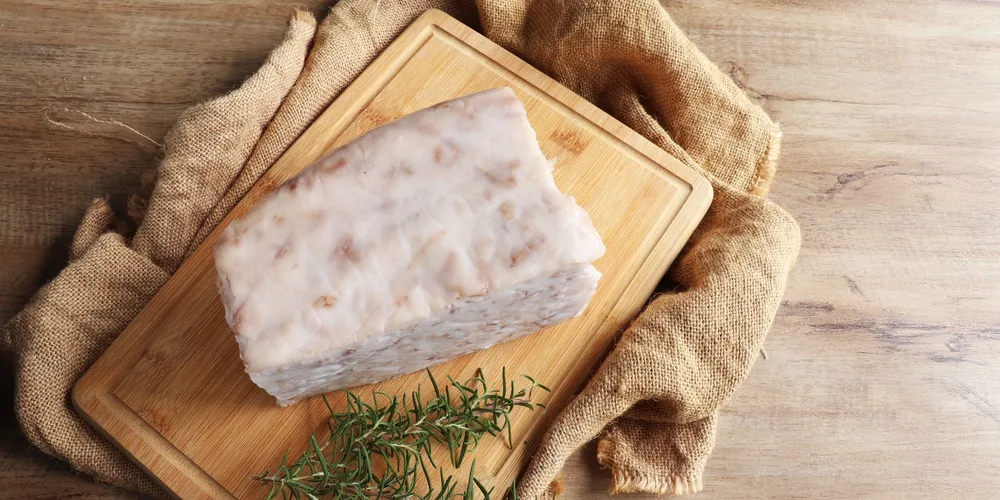
Wholesale pork fat is chosen by what you will make from it: for curing and smoking you take shoulder fatback, for salo with layers of meat — rind-on belly, and for mititei and sausages — trimmings, which already have the fat mixed into the meat. All these formats are in our frozen pork catalogue and in the chilled range. Below: what each one does, how to choose it and how to store it.
Which pork fat is in the catalogue?
- “Pork shoulder fatback, frozen” — the clean layer of fat, with no meat.
- “Pork belly, boneless, rind-on” — chilled, layers of meat and fat, with the rind.
- “Pork belly, frozen, 18 kg” — the fatty cut, in 18 kg cases.
- “Pork belly, bone-in” — chilled, with the ribs.
- “Pork trimmings 70/30” — working meat with 30% fat, frozen.
For cured and smoked salo: shoulder fatback
Shoulder fatback is the clean layer of fat, with a firm texture. That firmness is exactly what makes it right for brine, for dry curing and for smoking: it holds its shape, slices thinly and does not go soft. It is the classic raw material for salted salo with garlic, for smoked salo and for larder specialities. It comes frozen; thaw it in the fridge before curing, not at room temperature.
For salo with meat and porchetta: rind-on belly
Boneless rind-on belly has layers of meat and fat. The rind is what turns belly into a dish: it holds the salo together in the brine, crisps up in the oven and gives the texture people look for in traditional specialities. It is the cut for salo “with meat”, for porchetta and for roast belly. Being chilled, it goes straight into work.
If you work in volume, the frozen belly in 18 kg cases is the format for smokehouses: it is sliced for the grill, diced for stews or used as raw material for smoking. The chilled bone-in belly is slow-roasted or smoked whole.
For cracklings and lard
Cracklings and white lard are also made from shoulder fatback: diced and rendered slowly, it gives clean lard for cooking, and what remains are the cracklings. The lard is poured hot into clean jars and kept cool.
For mititei and sausages: 70/30 trimmings
Mititei and fresh sausages need fat to stay juicy. The simplest option is 70/30 pork trimmings — 70% meat, 30% fat —, which go straight into the mincer without weighing the fat separately. Those who work to their own recipe start from leaner meat and add minced fatback, to the gram. What other raw material sausage makers use is in our meat processing raw materials category and in our guide to sausage production.
How to store pork fat
- Frozen, at −18 °C, constantly. Fat absorbs smells easily, so keep the packaging closed.
- Thaw in the fridge, at 0 to +4 °C. Anything thawed is not refrozen: thaw only what you will cure or render.
- Chilled goods (rind-on belly, bone-in belly) are kept at 0 to +4 °C and used within the product’s short shelf life.
The full rules are in our guide to storing and thawing meat.
What gets confirmed by phone
- Stock. The pork in our catalogue is not Qualiko product, and the product pages carry the note “Check stock with our sales team”. Stock is confirmed on every order — in December, well in advance.
- Packaging. The frozen belly comes in 18 kg cases; for the shoulder fatback and the trimmings, the packaging of the available batch is confirmed.
- Price. Per kilogram, VAT included. Where a product page shows a wholesale price, it is indicative and carries the date it was updated; otherwise it says “Price on request”. The final price is confirmed by our sales agent.
How to order
The minimum order is 70 kg and can be made up of any items — fatback, belly, meat, offal — in the same delivery. Send your list through the order request form or call +373 79 88 33 79 (WhatsApp, Viber, Telegram). In Chișinău, delivery usually takes 24–48 hours and costs 100 lei, free over 150 kg; we deliver across Moldova by refrigerated transport. We do not process online payments, and returns are not accepted.
Frequently asked questions
Is the pork fatback fresh or frozen?
“Pork shoulder fatback, frozen” is kept at −18 °C. If you want chilled fat with meat in it, for homemade salo, the catalogue has “Pork belly, boneless, rind-on”.
Which fatback is best for curing?
Shoulder fatback: it has the firm texture that holds up to brine and smoke. For salo with layers of meat, rind-on pork belly is used.
What fat goes into mititei?
For mititei and fresh sausages, the simplest option is 70/30 pork trimmings, which already have the fat in the meat. Those who work to their own recipe add minced fatback, to the gram.
How much does wholesale pork fatback cost?
The price is per kilogram, VAT included, and is confirmed by our sales agent. Where a product page shows a wholesale price, it is indicative and carries the date it was updated; otherwise the page says “Price on request”.